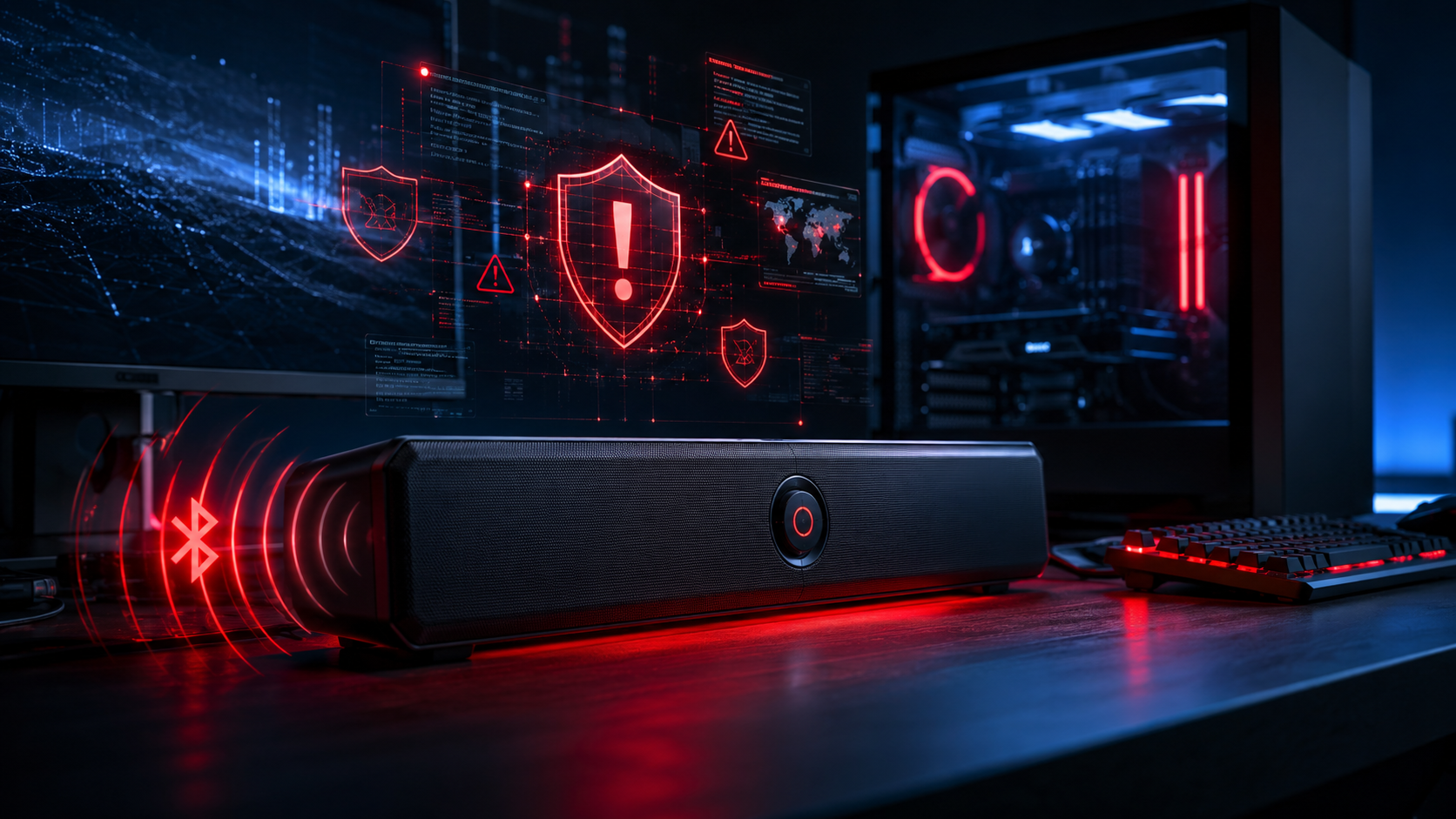
A reported security flaw in Creative's Sound Blaster Katana V2X gaming soundbar has raised fresh concerns about connected audio devices. The issue shows how a speaker connected to a PC can become more than an audio accessory if its Bluetooth and firmware controls are not properly protected.
What Researchers Found
Security researcher Rasmus Moorats reported that the Sound Blaster Katana V2X could be attacked over Bluetooth from nearby range without normal pairing or physical access. The issue reportedly involves an unauthenticated Bluetooth interface and weak firmware protections.
In a demonstration, modified firmware could make the device behave like a USB keyboard connected to a PC. That type of attack is serious because a fake keyboard can send keystrokes and potentially run commands on a computer.
Why This Is in the News
The story is getting attention because most people do not think of speakers and soundbars as security risks. But modern audio devices can include Bluetooth, USB connections, firmware update systems, mobile apps, and embedded operating systems.
If those systems accept unauthenticated commands or unsigned firmware, attackers may be able to abuse the device in unexpected ways.
Why Firmware Security Matters
Firmware is the low-level software that controls hardware. When a device allows firmware changes without strong authentication and signing, attackers may be able to replace trusted behavior with malicious behavior.
Firmware signing helps prove that an update came from the real manufacturer. Without it, a device may accept code that looks like an update but actually changes how the device behaves.
Key Points
- A researcher reported a Bluetooth-based flaw in the Sound Blaster Katana V2X.
- The attack may work from nearby range without normal pairing.
- Modified firmware could make the soundbar behave like a USB keyboard.
- The issue highlights risks in connected audio and gaming devices.
- Firmware signing and authenticated update paths are important protections.
- Users should follow vendor guidance and avoid exposing unnecessary wireless features when possible.
Impact on Users
The risk depends on the user's setup, distance, and whether an attacker is nearby. Still, the report is a reminder that USB-connected accessories can affect computer security if they are compromised.
Gamers and PC users should treat connected accessories as part of their security surface. That includes soundbars, webcams, keyboards, mice, docks, and smart home devices connected to the same computer or network.
What Makes This Concerning
The most concerning part is that the attack does not rely on a normal phishing email or downloaded file. It targets the device itself. If a device can be changed wirelessly and then act as trusted USB hardware, the computer may not immediately recognize the danger.
This is why hardware makers need clear update authentication, security disclosure processes, and fast patching when researchers report serious findings.
Conclusion
The Katana V2X report shows that cybersecurity is not limited to PCs, phones, and routers. Any smart accessory with wireless control and firmware update capability can become a risk if security is weak. Users should stay alert, and manufacturers should treat connected device security as a core product requirement.
Source reference: Google News technology feed, Tom's Hardware, Ars Technica, Privacy Guides